Blepharoplasty: Restoring Youth and Freshness to the Window of Your Face
The eyes are, without exaggeration, the most captivating focal point of the face—and the first place where signs of fatigue, aging, or even genetic predisposition show up. Drooping upper lids, under-eye puffiness, fine wrinkles, and protruding fat pockets can make a vibrant face look perpetually tired or stern. Blepharoplasty, or cosmetic eyelid surgery, is the procedure that clears and refreshes that window—often not just for beauty’s sake, but to restore lost visual function.
Simply put, blepharoplasty reshapes the eyelids by removing excess skin, repositioning or excising bulging fat, and sometimes tightening the underlying muscle. It can be performed on the upper lids, lower lids, or both.
According to the 2023 global survey by the International Society of Aesthetic Plastic Surgery (ISAPS), blepharoplasty ranks as the fourth most popular cosmetic surgical procedure worldwide, with over 1.5 million operations performed annually. That number alone speaks volumes about how much people value the impact of bright, open eyes on overall facial appearance.
Why Do Eyelids Sag and Puff?
Eyelid skin is the thinnest in the entire body—barely half a millimeter thick. This very delicacy means it’s the first to surrender to gravity, collagen loss, and the natural decline of elastin as we age. The protective fat pads that cushion our eyeballs can herniate forward, creating that “baggy” look. In some individuals, these changes have a genetic origin and become noticeable as early as the twenties.
Then there is ptosis—a true drooping of the upper lid margin itself, often caused by a stretched levator muscle. When the lid edge descends far enough to block the upper visual field, patients find themselves constantly raising their eyebrows or tilting their head back just to see clearly. In such cases, eyelid surgery becomes a medical necessity, often covered by health insurance after a visual field test confirms the obstruction.
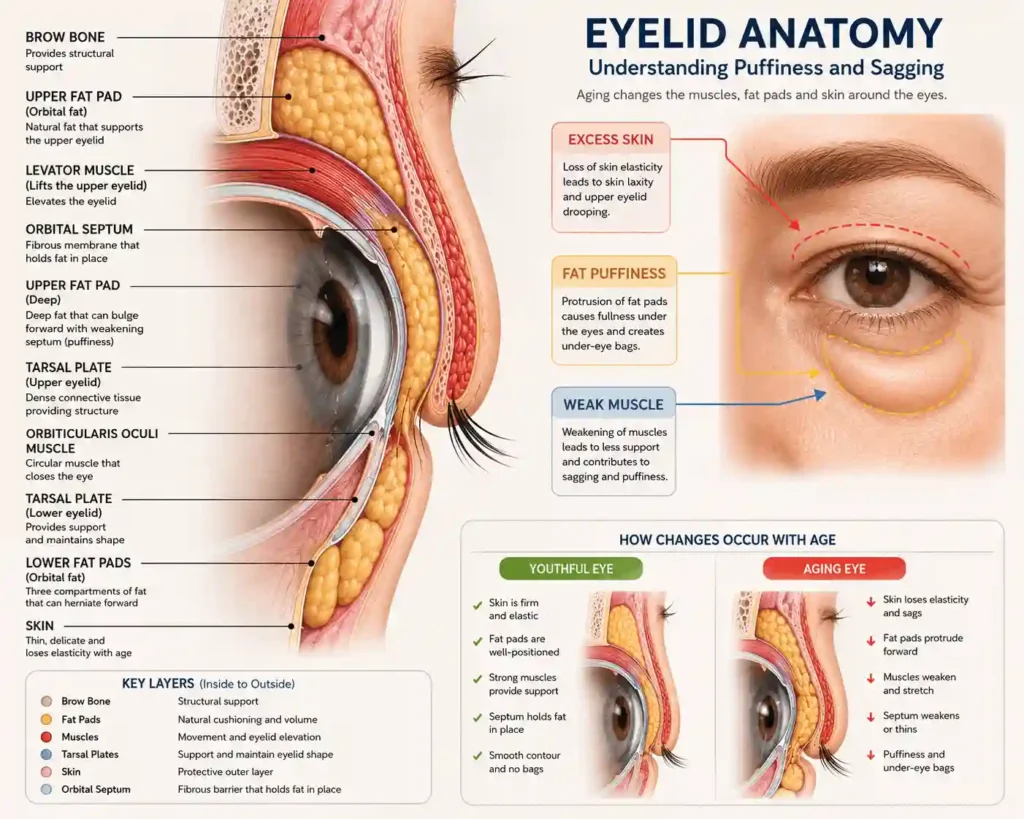
Eyelid Anatomy – Understanding puffiness and Sagging
Who Is a Good Candidate?
It’s not about age. A typical blepharoplasty patient could be 35 and bothered by hereditary under-eye bags, or 65 with upper lid skin resting heavily on the lashes. The most common concerns that bring people to a surgeon’s office include:
- Excess upper eyelid skin creating a tired, heavy appearance.
- Persistent puffiness or fat bulges under the eyes.
- Fine wrinkles and crepey skin around the eyes.
- Obstructed superior visual field due to severe lid droop.
- Desire to create or enhance an upper eyelid crease (common in Asian blepharoplasty).
While about 90% of blepharoplasties are performed on individuals over 40, younger patients with genetic predispositions are certainly routine.
Types of Blepharoplasty: Upper, Lower, and Combined
Blepharoplasty is never a one-size-fits-all operation. Depending on the problem, the surgeon focuses on the upper lids, lower lids, or both.
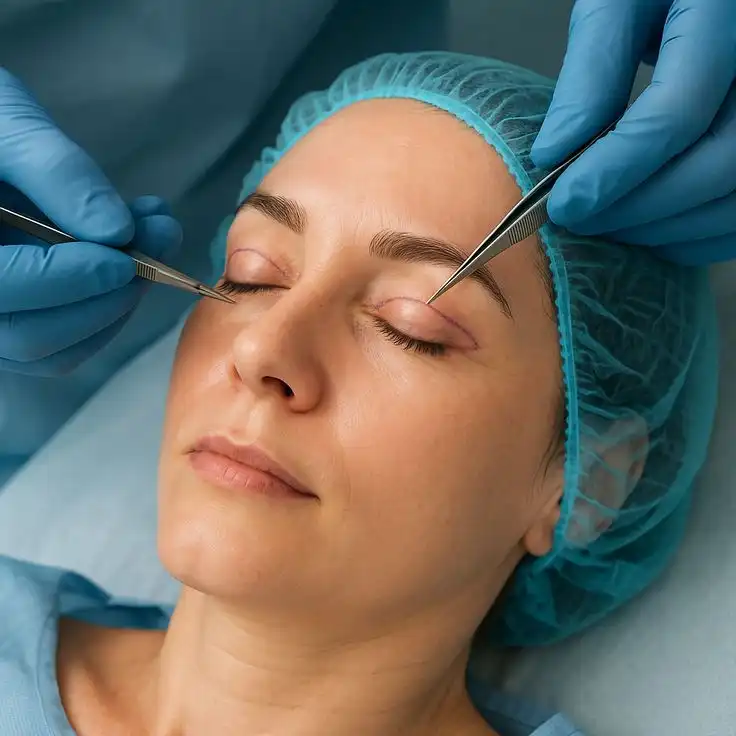
Upper Blepharoplasty : An incision is hidden within the natural upper lid crease. Excess skin is trimmed, protruding fat is conservatively removed or repositioned, and the orbicularis muscle may be tightened. The resulting scar tucks perfectly into the crease and fades to near invisibility. If true ptosis is present, the surgeon simultaneously repairs the levator muscle.
Lower Blepharoplasty: The chief goal is to eliminate under-eye bags and smooth fine lines. Two main approaches exist. The transcutaneous method uses an incision just below the lash line; this allows removal of excess skin along with fat. The transconjunctival approach places the incision on the inner side of the lower lid (conjunctiva). No skin scar is left externally, but it cannot address skin excess—making it ideal for younger patients who still have good skin elasticity.
Quad Blepharoplasty (All Four Lids): Many patients opt to treat both upper and lower lids in a single session. The result is a more harmonious, balanced rejuvenation.
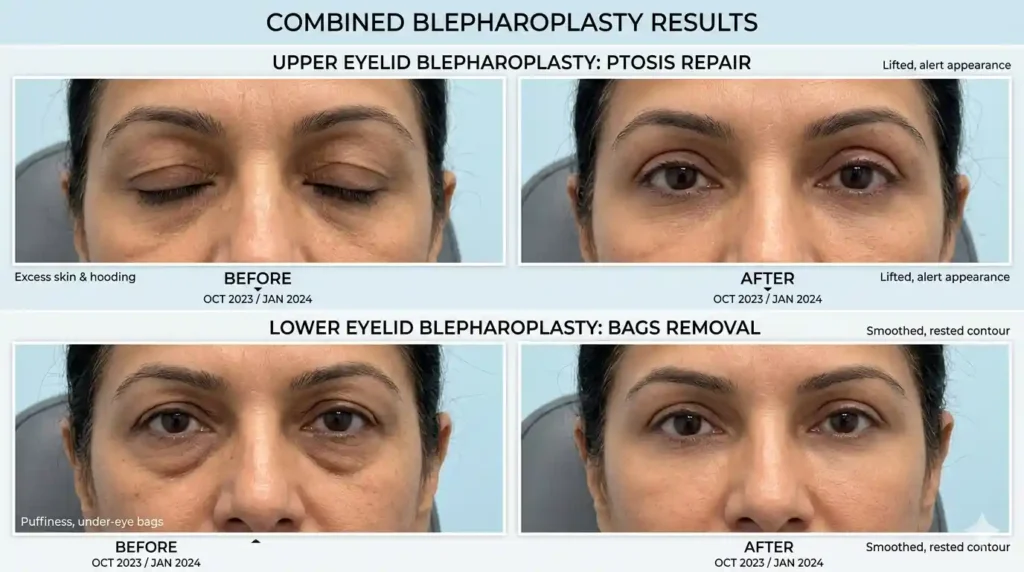
Before and After Blepharoplasty – Natural, harmonious results for upper and lower eyelids
Functional Blepharoplasty: When Drooping Lids Threaten Sight
For a subset of patients, eyelid surgery has nothing to do with vanity. When upper lid droop is severe enough to block the superior visual field, it can cause chronic eye strain, tension headaches from constant brow elevation, and difficulty driving or reading. This is functional blepharoplasty. A preoperative visual field test quantifies how much peripheral vision has been lost. Because the procedure directly improves quality of life, it is often eligible for insurance coverage.
Blepharoplasty vs. Brow Lift vs. Fillers
People often confuse these. Blepharoplasty addresses the eyelids themselves. A brow lift corrects a drooping forehead and descended eyebrow tail. Sometimes a low brow mimics excess upper lid skin; if the surgeon misdiagnoses the cause and operates only on the lids, the result can look unnatural. That’s why an expert assessment always checks brow position first.
Fillers or fat grafting can fill hollow tear troughs, but they cannot remove excess skin or bulging fat pads. They are complements, not substitutes.
The Surgical Journey: From Consultation to Operation Room
It all begins with a thorough consultation. The surgeon reviews your medical history, performs a detailed examination of the lids, measures the degree of drooping, assesses muscle strength, checks visual function, and takes photographs from multiple angles. If functional issues are suspected, a formal visual field test and sometimes an ophthalmology consult are ordered.
The procedure itself is typically done under local anesthesia with intravenous sedation; general anesthesia is also an option. The surgeon makes the planned incisions, meticulously trims skin and fat, tightens muscle if needed, and closes the incisions with extremely fine sutures. For all four lids, surgery time is usually between one and two hours.
After a short monitoring period, patients go home the same day. Antibiotic ointment is applied to the suture lines, and cold compresses are prescribed. Postoperative pain is remarkably mild and easily managed with over-the-counter analgesics.
Recovery: A Week-by-Week Guide
Patients are often surprised by how quickly they heal. Yes, the first few days bring swelling and bruising, but those fade remarkably fast.
Days 1–3: Swelling and bruising peak. Strict rest with the head elevated, frequent cold compresses, and prescribed eye drops. Limit screen time and reading.
Days 4–7: Bruises turn yellowish. Sutures are usually removed between day five and seven. Light daily activities can resume.
Week 2: Most of the swelling has subsided. Concealer may be applied to the incision line with the surgeon’s approval. Most patients return to work.
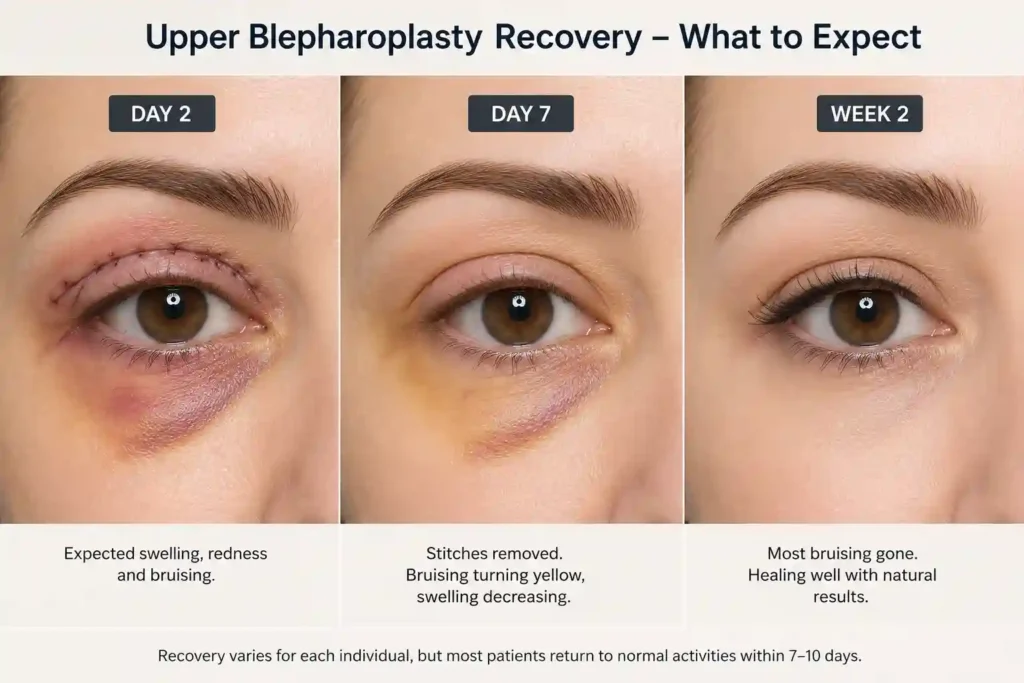
Blepharoplasty Recovery Timeline – Gradual reduction of swelling and bruising from day 2 to week 2
Month 1: Scars are pale pink and fading. The early surgical result becomes increasingly visible.
Months 3–6: Scars mature to near-invisibility, blending with the surrounding skin. The final lid contour is settled.
The outcome of blepharoplasty typically lasts between five and ten years. Natural aging continues, but the lids will always look significantly fresher than if the surgery had never been done.
Risks and Complications: An Honest Picture
Blepharoplasty is among the safest cosmetic procedures. Data published in Ophthalmic Plastic and Reconstructive Surgery puts the rate of serious complications below 1%.
Common, temporary side effects: swelling, bruising, dry eyes, tearing, light sensitivity, and mild blurred vision during the first few days. These are all part of normal healing.
Rare events: infection, retrobulbar hematoma (bleeding behind the eye), slight asymmetry, noticeable scarring, temporary difficulty closing the eyes fully, and in very rare cases lower lid malposition (ectropion). Choosing an experienced, board-certified surgeon and diligently following aftercare instructions dramatically reduces these risks.
Final Word: Let Your Eyes Speak
In skilled hands, blepharoplasty doesn’t perform magic. It simply gives back what years of fatigue and aging have taken from your face. You won’t look like someone else. You will look like yourself—only with clearer, brighter, more open eyes, and a face that no longer constantly apologizes for looking tired.
If under-eye puffiness or drooping lids have been frustrating you for years, and this article has answered some of your questions, the next logical step is a personal consultation. A conversation where all your worries are heard, and a realistic picture of what’s possible for your eyes is drawn for you.
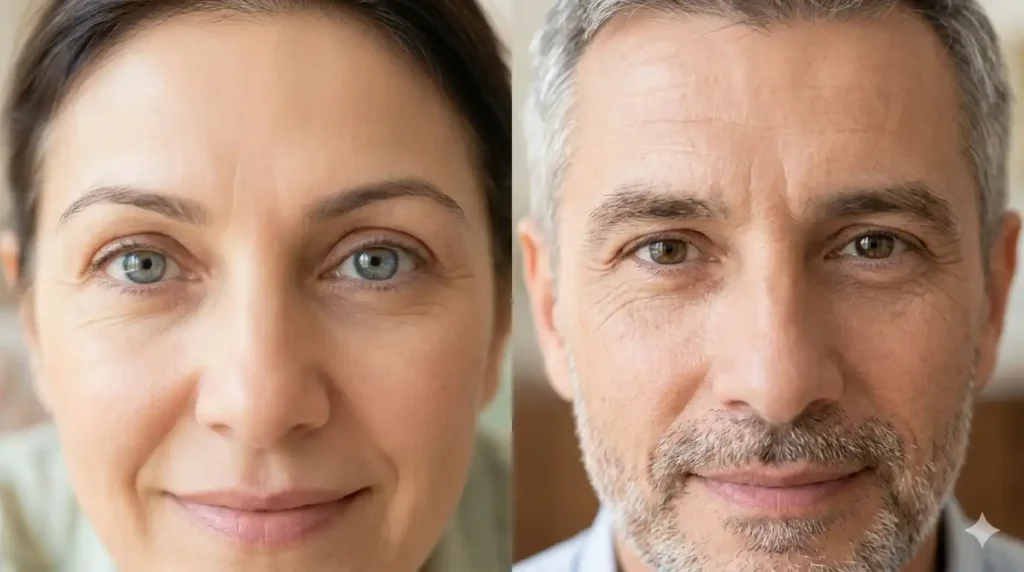
Natural Portrait of Clear, Open Eyes – The confidence that shines through your gaze